
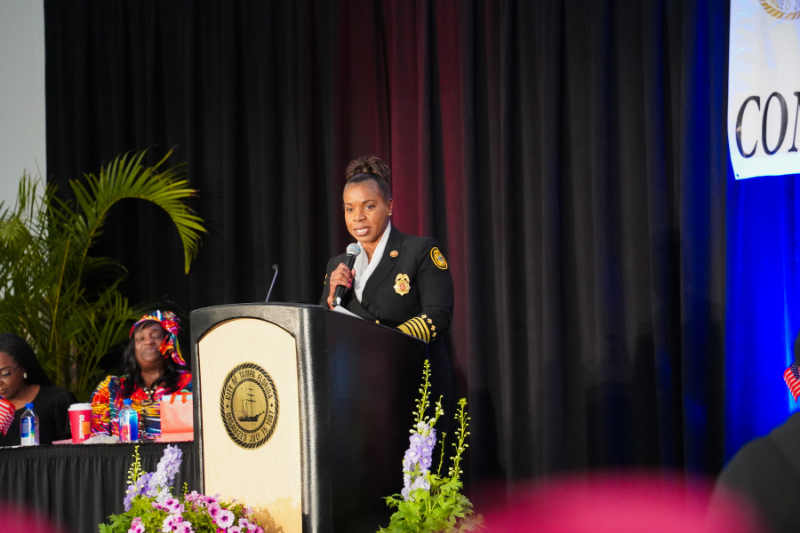
Chief Barbara Tripp’s Speech from the 2026 City of Tampa Black History Celebration
Thank you for the introduction.
First giving honor to GOD.
To the City of Tampa Black History committee, Mayor Castor, City Council Members, dignitaries and my community. Good morning and welcome to the 38th Annual Black History Celebration.
I am deeply honored to be here today and to have been chosen to say a couple of words as we celebrate a triumphant year.
What does that mean. It means to provide service to mankind and freedom for all.
I would like to define SERVICE:
S– Sacrifice is not measured by what is taken away but by what it makes possible, progress, freedom, and hope.
E-Encouragement is the voice that reminds us of who we are when doubt grows loud, and the steady hand lift us…. when the climb feels too steep
R-Resilience is the strength to rise after every fall, to endure hardship without surrendering hope. It is not the absence of struggle, but the determination to keep moving forward despite it.
V-Victory lives in the discipline behind the struggle, the unity behind the challenge, and the growth earned along the way.
I-Independence is more than freedom from control; it is the strength to shape your future without surrendering your voice.
C-Courage. Courage is the decision to act in the presence of fear. Courage speaks when silence feels safer, courage stands firm when retreat is easier, and chooses what’s right over what is comfortable.
E-Equality true equality ensures fairness in rights, justice in treatment and access to opportunity. Everyone holds the same worth, same dignity and the same right to be heard.
Today the City of Tampa Black History committee is celebrating and honoring 250 years of service and strength to our country and to our veterans who continue to fight for our freedom. Is it really 250 or 400 years.
Little known black history Fact: there is so much black history.
Why is black history month celebrated in February: Black history month originated from the Negro History Week, established by Carter G. Woodson 1926. He chose February because it coincides with the birthdays of Abraham Lincoln born February 12, who issued the Emancipation Proclamation and Fredrick Douglass born February 14, who was a former slave and a leading abolitionist.
July 4, 2026, America will celebrate 250 years of a document that was approved on July 4, 1776. What is that document- Declaration of independence.
Let’s dissect that document. The purpose of this document was about independence and freedom. It was the official announcement of the American colonies to separate from the British rule and to articulate the principles of individual rights and self-governance.
The adoption of this document was during a time of tension between the American colonies and Great Britian. The colonies were frustrated with policies, including taxation without representation, along with restrictions on their autonomy (independence). (Sounds familiar).
A group of men gathered in Philadelphia and voted. As history tells us, 56 delegates who represented the 13 Colonies signed the parchment paper on August 2, 1776, almost a month later. (sounds just like typical government).
They declared that the 13 colonies would no longer live under the rule of a distant king, that governments exist to serve the people, and declared a set of ideas that would exist across centuries:
Yes, the preamble of the Declaration of Independence.
We hold these truths to be self-evident, that all men are created equal, that they are endowed by their Creator with certain unalienable Rights, that among these are Life, Liberty and the pursuit of Happiness.
All people are created equal.
Liberty is a natural right.
Governments exist to serve the people
On that same day, July 4th in 1776, about 1/5th of the population of this new nation were enslaved. Black men, women, and children were not free. They were property. They were bought and sold. They were denied the very rights that the Declaration proclaimed to be universal.
The Declaration of Independence did not free everyone. For Black Americans, independence was promised in principle but denied in practice. The nation declared liberty while simultaneously protecting slavery. Truth is that Black Americans took the words of the Declaration seriously, even when the nation did not.
Harriet Tubman was a key figure in the Underground Railroad, leading numerous enslaved people to freedom and becoming a symbol of courage and resilience in the fight against slavery. Despite all the adversities Mrs. Tubman encountered, she did not give up and continued to serve her county for freedom and justice.
Frederick Douglass once asked, “What, to the American slave, is your Fourth of July?” It was a reminder that celebration and exclusion existed side by side. He also understood something powerful about the Declaration. It was not only a record of hypocrisy, it was also a moral contract, a standard against which America could be held accountable. In which Black Americans spent generations doing exactly that.
From the very beginning, Black labor helped build this country. Enslaved black American cleared land, cultivated crops, built roads, ports, schools, and government buildings. They generated enormous wealth that fueled the American economy and helped establish the nation’s global power. (Tulsa Oklahoma) Black Wall Street
Even under brutal conditions, Black people still created culture, community, and resistance. They preserved traditions and built families under threat of separation. They used faith, music, language, and storytelling to survive and to dream. The true irony of American independence is those that denied freedom helped make freedom possible.
Black abolitionists argued that if the Declaration was true, slavery was a lie. Black soldiers fought next to our white soldiers in every American war even before they were recognized as citizens. From the Revolutionary War to the Civil War, from World War I to Vietnam, Iraq, and Afghanistan, Black Americans defended a nation that often denied them full belonging.
During the Civil War, emancipation finally came not as a gift, but as the result of struggle, sacrifice, and bloodshed. The abolition of slavery was not an act of charity. It was a moral reckoning forced by Black resistance and allies who believed the Declaration’s promise must be honored.
After emancipation came Reconstruction a brief but transformative period when Black Americans voted, held office, built schools, churches, and businesses. But it wasn’t over. Here comes the Jim Crow laws, racial terror, lynching, and legalized segregation replaced slavery with a new system of control. Freedom existed on paper, but not in practice.
Through persistence, black Americans still had hope in the Declaration of Independence. They organized mutual aid societies, created historically Black colleges and universities. They built newspapers, professional associations, and cultural movements. They challenged injustice in courtrooms, classrooms, and streets.
America’s democracy survived not because it was perfect but because people refused to give up on its ideals. Through the Civil Rights Movement there was a demand not to invent new values but to live up to the old ones. Declaration of Independence.
When black children walked into integrated schools, when families marched across bridges, when people sat at lunch counters and boarded buses, they were doing more than protesting. They were claiming their inheritance under the Declaration of Independence.
The statement was, “if liberty is unalienable, it must be indivisible”. Courage is a component of service. Through the courage of whites and blacks, laws changed, barriers fell, and the nation moved closer to their promise.
So what does Independence mean now? 250 years later. It means that independence is not a destination, it is a process. It means that freedom must be protected, expanded, and renewed generation after generation. It means patriotism is participation, not silent. It is the courage to repair what has been broken and to tell the truth.
We know independence has never been abstract but meant access to education, have protection under the law, along with the right to vote and to be safe in our own neighborhood. For black Americans, independence meant opportunities without barriers and dignity without qualification.
Black Americans fought in every war not seeking special treatment, just demanding what was promise. Equal treatment under the principles declared in 1776.
This year we celebrate 250 years of independence not because the journey has been flawless but because it has been transformative.
We celebrate the progress made.
We honor the lives lost.
We acknowledge the unfinished work.
And we commit ourselves to the future.
Let us honor the past, confront the present, and shape a future where the promise of 1776 is not conditional, partial, or postponed but shared.
We should not only celebrate the mark of 250 years but reflect on the full story. To honor the truth that black history is NOT and NO ONE can tell us it is separate from American history. It is central to it.
As we celebrate 250 years and honor our veterans let us remember the resilience of our forefathers, those who fought and sacrificed their life so we can be free, the courageous men and women, who are serving our country, regardless of their race, ethnicity or gender
As we celebrate 250 years and honor our veterans let’s continue to encourage one another to stand strong and demand justice and peace for victory is ours.
As we continue to celebrate 250 years and honor our veterans let’s not criticize a brotha for taking a knee but understand his history, his belief when he hears “o’er the land of the free” or “One nation under GOD, indivisible with liberty and justice for all”
As we continue to celebrate 250 years and honor our veterans let us not forget our history that shaped this country to be the best country in the world and no one has the right to take that away from us.
Who cares who’s in the white house
Who cares who’s in the governor’s mansion
Who cares who has the most money and gets elected to office
If we stand united as one, we can overcome all obstacles because we are stronger together.
We cannot change the past, but we can change how we treat one another.
We cannot change the past, but we can show love instead of hate
We cannot change the past, but we can fight for justice and freedom for everyone
As we celebrate this year, let us remember that black history is not a footnote, it is a foundation. It teaches us that freedom grows when people insist on it and democracy deepens when voices once excluded are heard. America becomes more American when it tells the truth about itself. That’s democracy.
As we prepare to celebrate the next 250 years and honor our veterans let’s reflect on the preamble of the declaration of independence …..that all people are created equal.
As we prepare to celebrate the next 250 years and honor our veterans let’s not judge one another by the color of their skin but the content of their character.
As we continue to celebrate 250 years and honor our veterans let’s not forget our father who art in heaven
As I look back over my life, and see where I have come from, I can truly say that I have been blessed. Thank you City of Tampa Black History committee for honoring our veterans,
Thank you City of Tampa Black history committee for honoring our ancestors,
Thank you City of Tampa Black History Committee for honoring this colored girl who served in the United States Navy and I will continue to uphold strength and demand what’s rightfully mine…..that’s freedom.
May the City Tampa continue to be a city where history is respected, diversity is valued, and freedom is real for all.
Happy Black History Month. Happy 250th anniversary
God Bless you all. Thank you.
